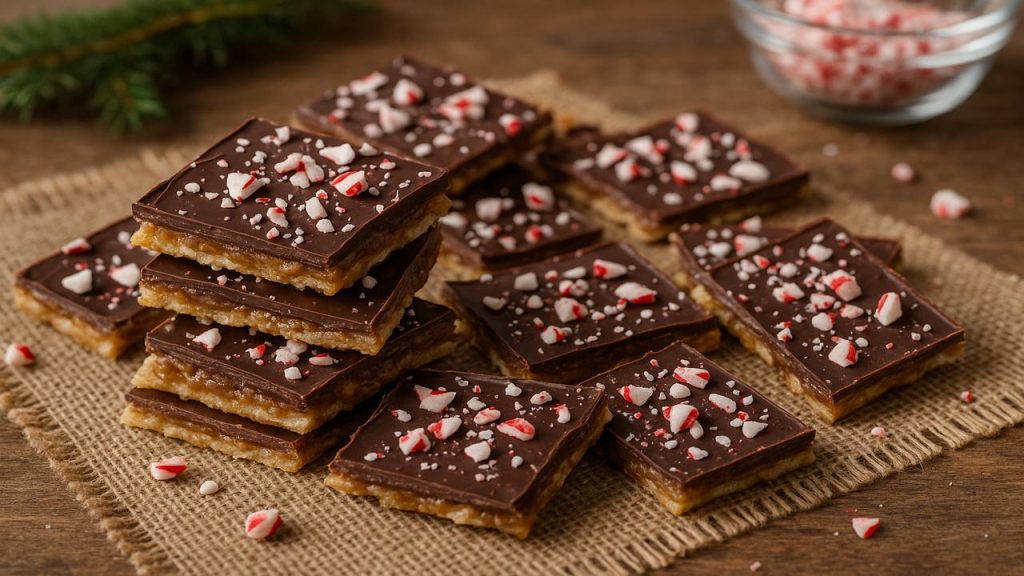
There are recipes that announce themselves with glitter and pomp, and then there are comforts that arrive with the quiet clink of a baking sheet, a kettle hissing on the stove, the warm perfume of brown sugar and butter. Christmas Crack — that cheeky name for saltine toffee — belongs to the latter. It’s a small, miraculous alchemy where humble crackers become glossy, brittle toffee caps studded with chocolate and flecked with peppermint. Make a batch and you’ll find the whole house leaning closer, hands reaching, cheeks flushed with sugar and laughter.
Why this simple treat tastes like holiday memory
There’s something about salt and sweet together that feels like standing barefoot on frosty grass—sharp and alive, then softened by warmth. Saltines give the toffee structure and that pop of salt that wakes up the chocolate. The toffee itself sings with caramel notes, each brittle shard echoing the stories told over steaming mugs: journeys home, a tree that refused to cooperate, the neighbor’s dog that always barks at sleigh bells. When you add peppermint, it’s like the cool air at the top of a hill after you’ve climbed; it refreshes the palate and keeps the sweetness from becoming heavy. The result is an edible winter walk—crisp, bright, and utterly moreish.
The simple alchemy: ingredients and quick facts
Part of the charm of Christmas Crack is how accessible it is. You don’t need an arsenal of gadgets or hours of attention—just a small, elegant list of ingredients and a little trust that the sugar will do its thing. Below is a compact table to keep beside your oven as you work.
| Ingredient | Quantity | Notes |
|---|---|---|
| Saltine crackers | About 40–45 (one sleeve) | Line a rimmed baking sheet tightly |
| Unsalted butter | 1 cup (2 sticks) | Melt low and slow |
| Light brown sugar | 1 cup, packed | Caramel base—stir constantly |
| Chocolate (chips or chopped) | 2 cups | Milk, semi-sweet, or a mix |
| Crushed peppermint | 2–3 tablespoons | Candy canes or peppermint chips |
Step-by-step: how this crack comes together
Preheat your oven and line a rimmed sheet with parchment—then fit those saltines snugly like a little silver-sparrow quilt. In a saucepan, melt butter and brown sugar together; watch them as they marry, bubbling and thickening into a glossy caramel. The noise the sugar makes as it reaches temperature is a tiny, satisfying hiss. Pour the hot caramel evenly over the crackers and bake briefly so everything sets and the crackers darken just at the edges. Remove the pan, scatter chocolate over the molten surface, and watch it bloom into silky pools as it softens. Spread the chocolate with the back of a spoon until it’s smooth, then send the peppermint snowfall across the top. Chill until firm and brittle, and then break into pieces—the sound is like walking on winter ice: clean and delightful.
Tips for peppermint perfection
Peppermint can be delicate—too large, and it can become cloying; too fine, and it loses its identity. Crush candy canes by placing them in a resealable bag and tapping with a rolling pin for a mixture of fine dust and small shards. If you prefer a milder hint, stir one teaspoon of peppermint extract into the melted chocolate rather than loading the top with heavy candy. For a grown-up touch, try mixing a little dark chocolate into the milk chocolate to add depth, or sprinkle a whisper of sea salt over the peppermint before the chocolate sets to amplify the contrast.
Gifting, storing, and the ritual of passing it on
One of the beauties of Christmas Crack is its portability. Wrap pieces in parchment and string them with twine, or stack them in a tin that can be passed hand-to-hand like a seasonal baton. Stored in an airtight container, it keeps well in a cool place for up to two weeks—though in many houses, it never lasts that long. If you live somewhere humid, refrigerate to preserve the snap, but allow the pieces to come back to room temperature for a few minutes before eating so the chocolate regains its creaminess.
Making Christmas Crack is less about culinary ego and more about generous work: stirring and pouring, listening to the sugar sing, and sharing the brittle treasures with people you love. The process itself is sensory—a ritual of heat and cold, salt and peppermint, silence and sudden crunchy applause. It’s the kind of recipe that turns ordinary evenings into small celebrations, a plate of shards that carries stories and warmth from one home to the next.
Frequently Asked Questions
Q: Can I use crackers other than saltines?
A: You can experiment with different thin crackers, but saltines are ideal because their light saltiness balances the toffee. Avoid overly sweet or flavored crackers.
Q: What chocolate works best?
A: Milk chocolate gives a classic, creamy finish; semi-sweet adds a more adult balance. Mixing the two lets you fine-tune sweetness and depth.
Q: How do I avoid soggy crackers?
A: Bake the caramel-topped sheet long enough for the topping to bubble and settle—this helps the crackers absorb just the right amount. Cooling fully in the fridge also helps maintain crispness.
Q: Can I make this gluten-free?
A: Yes—use a sturdy gluten-free plain cracker with a similar texture to saltines. Results vary by brand, so pick one that holds up under moisture.
Q: Is there a stovetop hazard I should watch?
A: Hot sugar is deceptively dangerous—use a heavy-bottomed pan, stir constantly to prevent burning, and keep children safely away while you’re boiling the caramel.