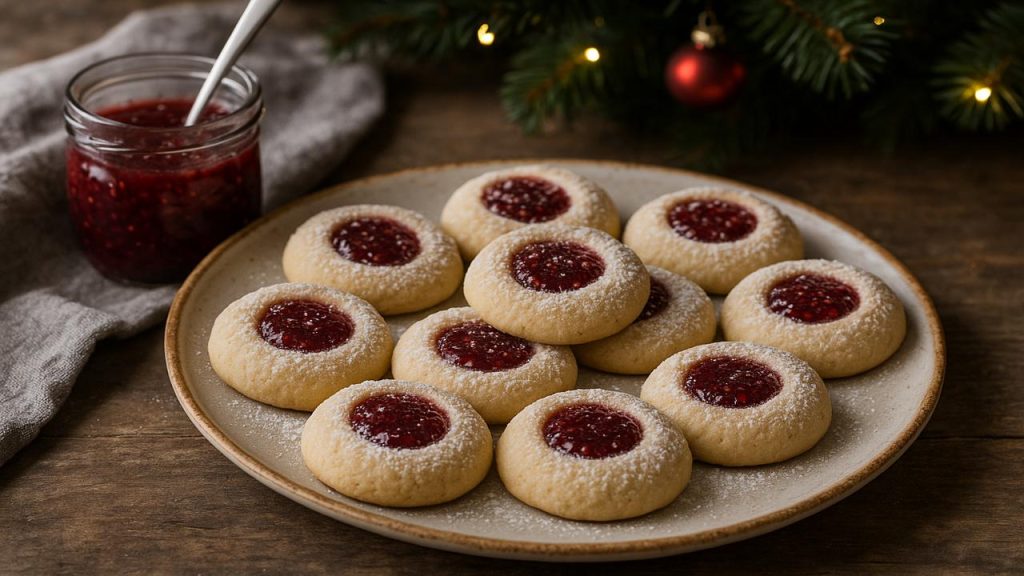
The oven hums like a winter river, steady and familiar. A small dusting of flour clings to my fingertips and the warm scent of butter rises like a memory — cinnamon, citrus, a hint of vanilla — all promising the soft, round comfort of thumbprint cookies. They are simple: a tender shortbread cradle pressed by a thumb, a dash of jam as bright as a cardinal against fresh snow. But to make them at Christmas is to weave together taste and ritual, to fold quiet afternoons into packages of joy that travel well from kitchen to porch and hand to hand.
Why these cookies feel like winter
There’s an intimacy to thumbprint cookies that other confections don’t quite capture. Rolling dough in your palms warms the fingers, reminiscent of holding someone’s hands across a table. The act of pressing a thumb creates a small hollow — a tiny landscape ready to receive a jewel of raspberry jam. That little red center pops like a holiday ornament. When the cookies emerge from the oven, their edges are softly browned and their centers still tender, giving way to a gentle bite that carries crisp butter and the tart brightness of berry. On a cold afternoon, their warmth is a small, private sun.
Ingredients that smell like the season
Good baking often begins with what you keep in your pantry: butter wrapped in gold, jars of preserves with labels softened by years, a bowl of flour waiting like snow. For Christmas thumbprint cookies, the rhythm is simple — flour, butter, sugar, an egg, and a whisper of vanilla. But it’s the extras that turn them festive: lemon zest for a crystalline lift, a pinch of cardamom or cinnamon if you like that woodsmoke-tinged warmth, and the raspberry jam, bright and fragrant enough to cut through any richness.
The simple pantry list
| Ingredient | Amount | Notes |
|---|---|---|
| Unsalted butter (room temperature) | 1 cup (225 g) | Soft, not melted |
| Powdered sugar | 1/2 cup (60 g) | Sifted for smoothness |
| All-purpose flour | 2 cups (250 g) | Spoon and level |
| Egg yolk | 1 large | Adds richness |
| Vanilla extract | 1 tsp | Or almond for depth |
| Raspberry jam | 1/2 cup | Seeded or smooth |
| Zest (lemon or orange) | 1 tsp | Optional, for brightness |
| Pinch of salt | — | Balances sweetness |
Making the dough: a quiet ritual
There’s a tactile pleasure in creaming butter and sugar until the mixture lightens like early morning fog. I use a wooden spoon when I want to feel the texture, a stand mixer when I’m lazy, but either way the goal is the same: a pillowy base that catches the flour and makes the dough tender. Fold in the flour gently — overworking makes the cookies tough — and finish with the yolk and a breath of vanilla. The dough will feel like a soft pebble; if it seems dry, a teaspoon of milk will coax it into the right consistency.
Rolling the dough into small balls is a meditation. Make them walnut-sized, then plate them on a baking sheet with space to breathe. When you press the thumb into each one, don’t aim for perfection; the little unevennesses are the map of your hands, the signature of an afternoon spent baking. Fill each dimple with a drop of jam that’s neither too hot nor too cold — it should shine like a red lantern.
Baking and finishing touches
These cookies bake quickly. The oven should be a friendly, even heat — 350°F (175°C) is ideal. Watch for the edges to turn just a whisper of gold while the centers remain pale and soft. Overbake and you lose that melt-in-the-mouth quality, so I check at the eight-minute mark, then every minute after. Once out of the oven, cool them on the sheet for a few minutes; the jam will set and the shortbread will firm up but keep its tenderness.
Variations and little flourishes
Try rolling some cookie balls in finely chopped pistachios, sanding sugar, or a dusting of cinnamon before baking for a textured edge. A tiny dab of lemon curd in place of raspberry makes for a sunnier bite, while a sprinkle of flaky sea salt over the jam right after baking gives a sophisticated contrast. For a rustic twist, press an almond into the center along with the jam to add a roasted note.
Serving, gifting, and storing
On a wooden tray lined with evergreen sprigs, these thumbprints become a story. They are small and unassuming, yet they carry the capacity to comfort. Serve them with black tea, strong coffee, or a glass of cold milk. To gift, stack them in parchment-lined tins, tuck in a sprig of rosemary, and tie the lid with twine. They travel well, and their aroma will make anyone opening a tin feel like they’ve just walked into your kitchen.
Store cookies in an airtight container for up to a week; if you’d like them to keep longer, freeze the plain baked cookies (without jam) and add the preserved jewel after thawing. The jam can be gently warmed to a spreadable consistency before filling, ensuring it nestles into the indentation like a tide returning to a hidden bay.
FAQ
Q: Can I make the dough ahead of time?
A: Yes. The dough can be wrapped and chilled for up to 48 hours or frozen for up to a month. Let it come to a cool, workable temperature before rolling.
Q: My jam is too runny — what should I do?
A: Gently simmer the jam to reduce excess moisture, or mix it with a little jam sugar or cornstarch slurry, then cool before filling. Thicker preserves hold their shape better during baking.
Q: How small should I make the thumbprints?
A: Aim for walnut-sized balls (about 1 to 1.5 inches). Smaller cookies bake faster; adjust time accordingly and watch closely to prevent overbrowning.
Q: Can I use alternative flours?
A: You can substitute part of the flour with almond flour for a nuttier texture, but keep at least half all-purpose to maintain structure. Gluten-free blends designed for 1:1 substitution also work well.
Q: Any tips for making them extra soft?
A: Do not overbake, use room-temperature butter, and fold the dough gently. Adding a single egg yolk increases richness and tenderness; a teaspoon of corn syrup or honey can also help maintain softness.